
Battery discharging is the mandatory first step in EV battery recycling — yet it remains one of the industry's least mature processes. While recyclers have scaled shredding and material recovery, most still rely on manual teardowns and multi-day salt baths to remove charge from end-of-life batteries. As volumes increase and packs arrive with unknown state-of-charge and hidden damage, this bottleneck threatens the entire recycling supply chain.
Current Discharging Methods: Manual and Ad-Hoc
Before a battery can be safely shredded or reused, the energy has to be removed. In theory, that means isolating the pack, verifying its condition, and discharging it in a controlled, measurable way.
In reality, today's workflow looks more like this:
- Batteries arrive with unknown SoC and hidden faults
- Operators assess, photograph, and store them
- Discharge happens through one of two routes — depending on format
| Battery format | Current discharge method |
|---|---|
| Large modules / packs | Manual casing removal to access discharge points behind contactors — internal switches that close when batteries leave vehicles, blocking HV connector access |
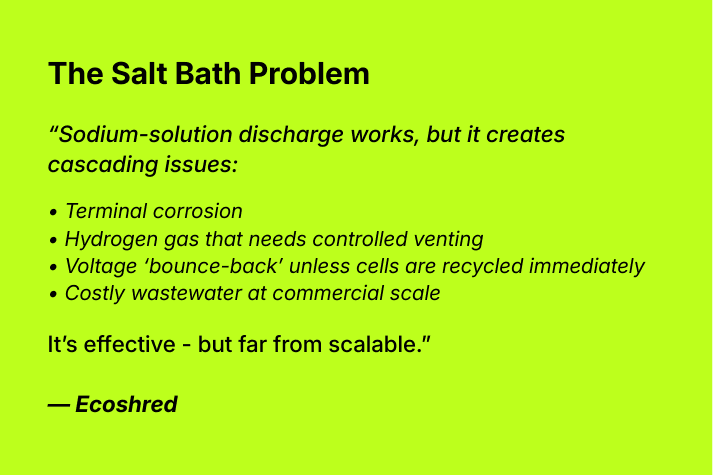
| Cells / smaller batteries | Sodium-solution salt baths (NaCl) for several days — the salt water conducts electricity and allows the battery to discharge electrochemically |
What operators say
"Most recyclers still rely on ad-hoc resistive setups or sodium baths — slow, hard to control, and unsafe as voltages rise. In practice it remains one of the least mature stages of the recycling chain." — RecoVolt
"Testing individual batteries after a sodium bath is problematic and time-consuming, and poses safety risks if any batteries aren't discharged correctly." — Ecoshred
"Manually unscrewing the top takes 1–2 hours of highly trained personnel's time. One alternative, carefully grinding through the cover, exposes employees to fire and electrocution hazard." — Wattloop
Why Discharging Is Getting More Dangerous
Today's recycling stream is still dominated by production scrap and warranty recalls — relatively predictable, relatively uniform. That's changing fast.
As true end-of-life packs enter the system at volume, recyclers will face:
- Hidden faults and water ingress
- Uneven SoC across cells
- Corroded busbars
- Swollen pouches
- Unpredictable BMS behaviour
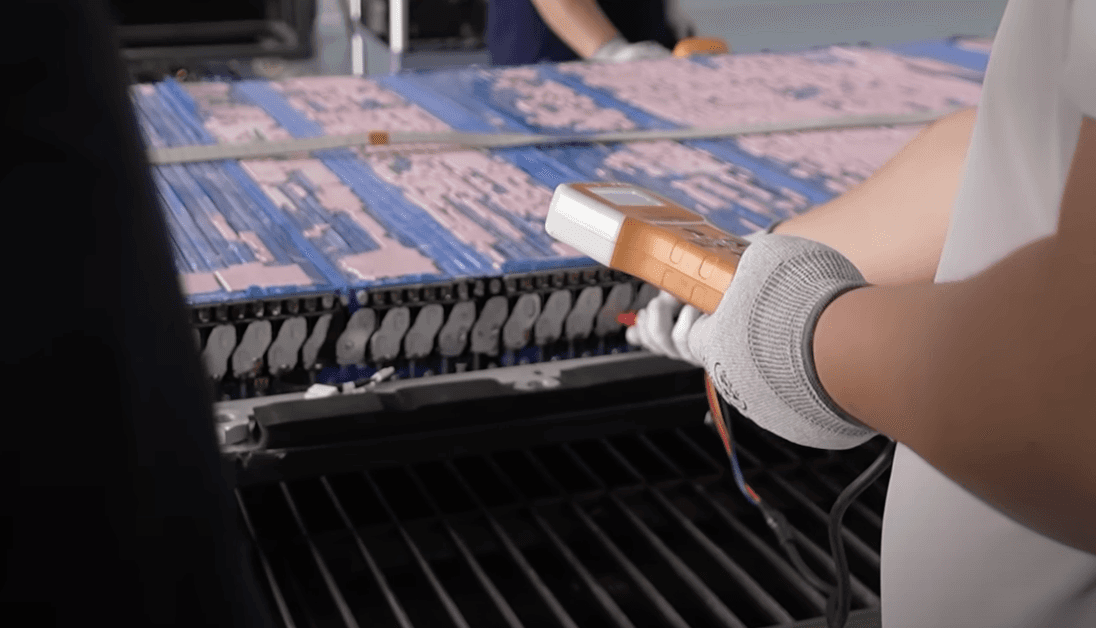
The BMS paradox makes it worse: battery management systems exist to prevent dangerous rapid discharge and thermal runaway — but recyclers must bypass them to achieve deep discharge with a cycler, introducing a new category of hazard at the exact moment the pack is most unpredictable.
What operators say
"For mechanical recyclers, discharged modules mean less shredder wear and drier black mass. Some recyclers are even finding that depth of discharge affects black mass quality." — Wattloop
"Huge variability between packs, even from the same model or manufacturer, makes each discharge event unique and difficult to automate without tighter process control." — RecoVolt
Source: France24
The Opportunity: Diagnostic Discharge
The solution isn't just better equipment — it's rethinking what discharge can do.
Rather than treating it as a safety checkbox before shredding, discharge could be the first diagnostic touchpoint: where recyclers simultaneously assess capacity, identify reuse candidates, and recover energy — instead of burning it off as heat.
Technologies already available
| Company | Capability |
|---|---|
| Bosch Rexroth | Regenerative discharge up to 1,000V — feeds energy back to grid; 5–15 min vs traditional 24 hours |
| REGATRON | Regenerative discharge systems up to 1,000V |
| No Canary | Regenerative discharge with grid feedback |
| Wattloop | Discharge via external HV connector before or during disassembly — discharge and automated dismantling can run concurrently |
Bosch's system discharges batteries in 5–15 minutes versus the traditional 24 hours. Wattloop's approach means "that operation becomes less dangerous and quicker — discharge and automated dismantling can happen concurrently."
What the future looks like
| Today | Future |
|---|---|
| Safety checkbox before shredding | First diagnostic step in the value chain |
| Energy burned off as heat | Energy recovered and fed back to grid |
| Manual per-pack decision-making | Automated assessment of reuse vs recycle |
| Single-format or ad-hoc setups | Universal systems handling cells, pouches, modules, and full packs |
"Discharge should be the first diagnostic step rather than a safety afterthought." — RecoVolt
"In an ideal world, we'd have a single discharging system capable of handling every format — cells, pouches, modules, and full packs — at industrial scale. That alone would remove the bottleneck." — Ecoshred
The Bottom Line
The players that figure out diagnostic discharge — systems that simultaneously deactivate, assess, and recover value — will have a structural advantage as end-of-life volumes scale.
Everyone else will still be dunking batteries in salt water.